
Nine vehicle classes from a 1-ton van to a 12-ton truck, one honest comparison. Pick the temperature band your cargo must never leave, then the size you can actually fill — and rent nothing bigger or colder than the job needs.
The short answer: rent a chiller van for fresh cargo up to about a ton across many city drops, a freezer van for small frozen loads, a 3-ton chiller truck for medium or mixed chilled-and-frozen loads, and a 5 to 12 ton refrigerated truck for bulk, wholesale and cross-emirate runs.
Every other decision sits underneath that one. This page puts all nine classes we rent side by side — temperature band, payload, the routes each one wins on, what is included and what it costs to hold one by the day or the month — then walks through the six comparisons customers ask us about most. If you would rather answer three questions than read a table, start with the vehicle finder below.
Answer for a normal working day, not your busiest one. The match updates as you choose.
01 What must the cargo stay?
Answer all three questions to see the vehicle we would send.
The finder applies the same logic our dispatch team uses: temperature band first, then first-drop fill, then the door at the other end.
Temperature band, payload, body and the jobs each vehicle is built for — and the jobs it is the wrong choice for. Click any vehicle for full specs.
| Vehicle | Temperature band | Payload | Body | Wins on | Wrong choice for |
|---|---|---|---|---|---|
| 1-Ton Chiller Van | +5°C to 0°C | up to 1,200 kg* | Compact insulated box | 10+ city drops, restaurants, cafés, florists | Anything frozen; pallet loads |
| Freezer Van | 0°C to -18°C (to -25°C) | up to 1,000 kg* | Insulated deep-freeze box | Ice cream, frozen seafood, frozen multi-drop | Fresh produce and flowers |
| 3-Ton Pickup Truck | +5°C to 0°C | up to 3,000 kg* | Open pickup / enclosed box | Market runs, wholesale pickups, mixed-use days | Long multi-drop chilled routes |
| 3-Ton Chiller Truck | +5°C to 0°C · dual-zone to -18°C | up to 3,000 kg* | Enclosed box, dual-zone optional | Supermarket top-ups, catering, mixed loads | Very tight old-town access |
| 5-Ton Freezer Truck | -18°C to -25°C | up to 5,000 kg* | Enclosed deep-freeze box | Frozen wholesale, port seafood, cold-store transfers | Small chilled drops |
| 5-Ton & 10-Ton Truck | +5°C to -25°C | 5,000–10,000 kg* | Large enclosed box, tail-lift optional | Bulk distribution, intercity corridors | Residential and mall addresses |
| 7–12 Ton Chiller Truck | +5°C to -25°C | 7,000–12,000 kg* | Heavy-duty insulated body | Full-pallet DC runs, cross-emirate bulk | Peak-hour city deliveries |
| Refrigerated (Reefer) Truck | +25°C to -25°C | 5,000–10,000 kg* | Full-range reefer body | Ambient-to-frozen in one vehicle, project cargo | Light, frequent drops |
| Tail-Lift Truck | +5°C to -25°C | 3,000–10,000 kg* | Truck body with hydraulic lift | Heavy pallets to sites with no dock or forklift | Van-sized loads |
* Payload figures marked with an asterisk are placeholders — replace with your verified fleet specifications before launch. Scroll the table sideways on mobile.
Every refrigerated vehicle is built around a temperature band. Pick the band your product must never leave, and the shortlist shrinks from nine vehicles to two or three.
For product-by-product setpoints, see our refrigerated transport temperature guide.
Cold is not stored in the air inside a refrigerated body. It is stored in the cargo. A litre of chilled product holds roughly three thousand times more cold than a litre of air, so a full body is a thermal battery and an empty one is a balloon of air waiting to be swapped. Every time the doors open on a +40°C street, that air is what leaves — and in a half-empty truck there is a lot of it to lose, with very little cargo to absorb the hit while the unit pulls the box back down.
That is why renting bigger “to be safe” backfires twice: you pay a higher daily rate, and the temperature swings harder at every stop. The rule our dispatchers use is simple. Size to the load at the first drop of a normal day. If that load fills less than about half the body, step down a class or split the route across two smaller vehicles. Undersize and you lose the cargo buffer; oversize and you lose the air. The right vehicle sits in between — and it is almost never the biggest one.
Short answers to the decisions that come up on almost every quote call, each with a clear verdict.
| Chiller van | Freezer van | |
|---|---|---|
| Band | +5°C to 0°C | 0°C to -18°C (to -25°C) |
| Fails when | Too warm or too cold | Too warm |
| Daily cost | Lower | Higher — the unit works harder |
| Wrong for | Anything frozen | Produce, flowers, fresh dairy |
Verdict: Choose by the state of the cargo, never by "colder is safer". A freezer run warm is unstable, and a chiller run at its coldest cannot hold frozen. Full guide: chiller van vs freezer van.
| 1-ton van | 3-ton truck | |
|---|---|---|
| Payload | up to 1,200 kg* | up to 3,000 kg* |
| Drops per day | 10–20+ city stops | 5–12 larger stops |
| Access | Basements, old town, malls | Main roads, service yards |
| Dual-zone | No | Optional |
Verdict: Under a ton across many doors, the 1-ton van wins every time. Once a single run carries more than a ton or mixes chilled with frozen, step up to the 3-ton truck.
| 3-ton chiller truck | 3-ton pickup | |
|---|---|---|
| Body | Enclosed, refrigerated | Open bed or enclosed box |
| Temperature hold | Full route, every drop | Short runs, quick unloads |
| Best for | Multi-drop chilled supply | Market and wholesale pickups |
| Flexibility | Cold-chain only | Chilled and general cargo days |
Verdict: If the cargo is temperature-sensitive for the whole route, take the chiller truck. The pickup suits short, mixed-use days where speed of loading matters more than a long cold hold.
| Single-zone | Dual-zone | |
|---|---|---|
| Compartments | One band | Two sealed bands |
| Typical load | All chilled or all frozen | Chilled and frozen on one route |
| Cost | Lower | Higher than one truck, lower than two |
| Watch for | Mixed loads at a compromise setpoint | Fill both zones evenly |
Verdict: Never run mixed cargo at a "middle" temperature — it is too warm for frozen and too cold for fresh. If both travel together, the dual-zone 3-ton truck or a larger dual-zone truck replaces a second vehicle.
| 7–12 ton chiller truck | Reefer truck | |
|---|---|---|
| Band | +5°C to -25°C | +25°C to -25°C |
| Ambient control | No | Yes — holds a warm setpoint |
| Best for | Chilled and frozen bulk | Chocolate, wine, pharma ambient |
| Payload | 7,000–12,000 kg* | 5,000–10,000 kg* |
Verdict: For chilled or frozen bulk, the 7–12 ton truck carries more for the money. Choose the reefer truck when the cargo needs to be held warm in summer heat, not just cold.
| With our driver | Self-drive | |
|---|---|---|
| Who drives | Trained cold-chain driver | Your team |
| Temperature handling | Pre-cooling, loading, logs managed | Briefed at handover |
| Best for | New routes, pharma, long hauls | Own drivers, fixed daily routes |
| Licence | Not your concern | Correct UAE licence class required |
Verdict: Book a driver when the cold chain is new to you, the cargo is high-value or the route crosses emirates. Self-drive works for teams with their own licensed drivers on routes they already know.
* Payload figures are placeholders — confirm against your verified fleet specifications before launch.
The basics of a safe cold chain come with every booking. Specialist options depend on the vehicle class.
| Feature | 1-ton van |
Freezer van |
3-ton pickup |
3-ton truck |
5-ton freezer |
5–10 ton | 7–12 ton | Reefer |
|---|---|---|---|---|---|---|---|---|
| HACCP-certified, temperature logged | ✓ | ✓ | ✓ | ✓ | ✓ | ✓ | ✓ | ✓ |
| Pre-cooled before loading | ✓ | ✓ | ✓ | ✓ | ✓ | ✓ | ✓ | ✓ |
| Driver or self-drive | ✓ | ✓ | ✓ | ✓ | ✓ | ✓ | ✓ | ✓ |
| Same-day dispatch | ✓ | ✓ | ✓ | ✓ | ✓ | ✓ | ✓ | ✓ |
| Pharma band +2°C to +8°C | ✓ | — | ✓ | ✓ | — | On request |
On request |
✓ |
| Frozen –18°C or colder | — | ✓ | — | On request |
✓ | ✓ | ✓ | ✓ |
| Dual-zone compartment | — | — | — | On request |
— | On request |
On request |
On request |
| Tail lift | — | — | — | On request |
On request |
On request |
On request |
On request |
| Cross-emirate runs | ✓ | ✓ | ✓ | ✓ | ✓ | ✓ | ✓ | ✓ |
Option availability per class is a placeholder matrix — confirm against your live fleet before launch.
for fresh cargo. Produce, flowers and dairy suffer chill injury, and you pay more for it.
for frozen goods. It cannot hold −18°C, and thaw-refreeze ruins the load even if it arrives hard.
A half-empty body loses more cold at every stop and costs more every other day.
No dock and no forklift means heavy pallets need a tail lift — or a van-sized load.
Pharma needs the +2°C to +8°C band and a retained temperature log, not just a cold box.
Heavy vehicles face timing and access limits; vans keep delivering.
1-ton chiller van, daily multi-drop.
freezer van for retail drops, 5-ton freezer truck for wholesale.
chiller van or 3-ton truck in the logged +2°C to +8°C band.
5-ton freezer truck at −25°C from port to cold store.
dual-zone 3-ton truck for top-ups, 7–12 ton for DC runs.
3-ton chiller truck, often with a tail lift, on weekend terms.
The order matters. Each decision narrows the next, so you never compare vehicles that could not do the job.
Fresh, frozen, deep frozen, pharma or mixed. This decides the vehicle family before size enters the picture.
Ten or more city doors favours vans and 3-ton trucks. One to three bulk drops favours 5 tons and up.
Pick the smallest body your normal first-drop load fills well. Split the route rather than run half empty.
Dock, forklift, kerbside or basement. That decides tail lift, body length and the time of day you deliver.
The vehicle decides the band and the size. The term decides what you pay for it — and how certain you are that it is there tomorrow.
| Daily | Weekly | Monthly | Long-term | |
|---|---|---|---|---|
| Best for | One-off jobs, events, breakdown cover | Seasonal peaks, short projects | Regular routes, steady volume | Permanent capacity, multi-vehicle fleets |
| 1-ton chiller van from | AED 200 / day | AED 700 / week | AED 1500 / month | Custom contract |
| Rate per day | Highest | Lower | Lower again | Lowest |
| Vehicle availability | Subject to fleet on the day | Held for the week | Locked to your routes | Dedicated vehicles |
| Read more | Daily rental | Weekly rental | Monthly rental | Long-term contracts |
Prices shown are placeholders — replace AED figures with your verified rates before launch. For a full breakdown, see the chiller truck rental cost guide.
We dispatch across Dubai and run regular cross-emirate corridors, so a single provider covers your whole route.
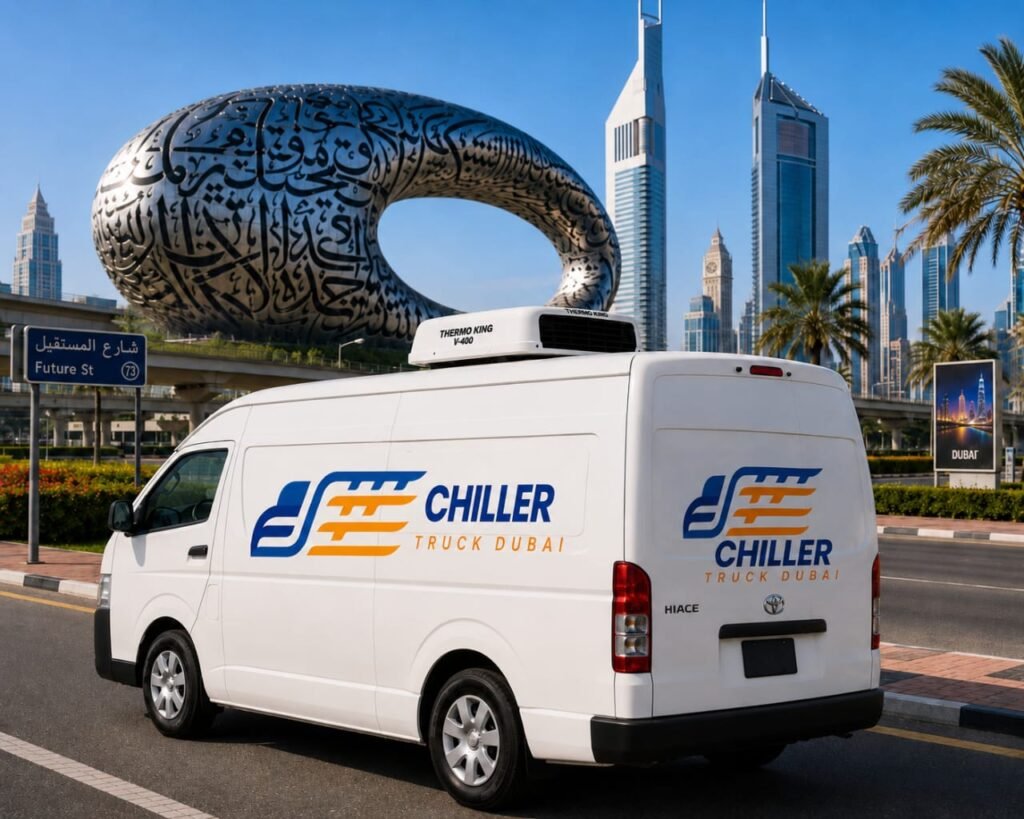
A chiller van holds fresh cargo cold but unfrozen at +5°C to 0°C. A freezer van takes cargo below freezing, to −18°C and as low as −25°C. A refrigerated truck is the larger body, 3 to 12 tons, and comes in chilled, frozen, full-range and dual-zone versions. Choose the temperature band first, then the size.
Size to the load you carry at the first drop of a normal day, not the biggest day of the year. As a rule of thumb, up to about 1 ton suits a 1-ton van, 1 to 3 tons a 3-ton truck or pickup, 3 to 5 tons a 5-ton truck, and anything heavier a 7 to 12 ton truck. If the first-drop load fills less than about half the body, step down a size or split the route.
Yes, in a dual-zone truck. A sealed bulkhead splits the body into two compartments running two different temperatures, so chilled and frozen goods travel on the same route without a second vehicle. Dual-zone is available on our 3-ton chiller trucks and larger trucks on request. A chiller van on its coldest setting is not a substitute.
For one or two bulk drops, one truck is usually cheaper per ton moved. For a dozen or more city drops, two vans often win: they reach more doors per hour, park where a truck cannot, avoid heavy-vehicle timing restrictions, and keep fuller bodies that hold temperature better between stops.
Only in the dedicated +2°C to +8°C pharmaceutical band, with temperature logging switched on and the records retained for your audit. Medicines need a validated band and a documented log, not just a cold box, so tell us the cargo is pharmaceutical when you book and we set and record the vehicle accordingly.
Any delivery where heavy pallets or cages arrive at a site with no loading dock and no forklift. Restaurants, hotels and retail back doors are typical. Tail lifts are fitted on trucks rather than vans, so if your unloading point is kerbside and the load is heavy, choose a tail-lift truck.
Send us the cargo, the number of drops and where it unloads. A cold-chain specialist will tell you which vehicle fits — and whether a smaller one would do the job for less.
