
Each sector fails cold in its own way — and needs its own vehicle, size and temperature. Find yours below: the right van or truck, the compliance it demands, and why it matters, from your point of view.
The most expensive mistake in cold transport is renting the truck first and forcing the cargo to fit. Ice cream in a chiller van, flowers set too cold, and pharma without a validated log—each is a load lost to the wrong vehicle.
This page works the other way around. Pick your industry to see the temperature band it needs, the vehicles that fit it with their sizes, the compliance it demands, and the one thing that most often goes wrong, then follow through to the full sector page. The whole chiller and freezer fleet is available to every industry below.
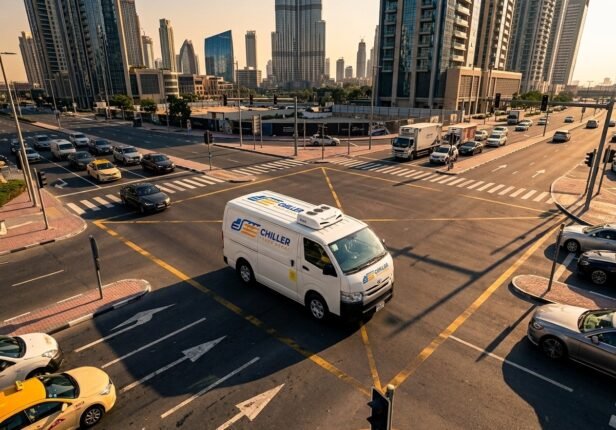
Temperature, recommended vehicles and the single priority that decides each sector — scan it product-first.
| At delivery | Without a tail lift | With a tail lift |
|---|---|---|
| Sites with no dock | Manual unloading, slow | Lowered to ground safely |
| Heavy pallets | Risk of injury & damage | Pump-truck off the platform |
| People needed | Several to lift by hand | One or two operators |
| Cold cargo | Longer door-open time | Quick, temperature held |
| Best for | Dock-to-dock only | Shops, venues, clinics, homes |
Every industry on this page has a different failure point, and none of them is ‘the truck was too small.’ Seafood is decided at the quay. Pharma lives and dies by the log. Flowers are ruined by being made too cold, not too warm. Frozen goods slip over a partial-thaw cliff you cannot see. A single vehicle spec cannot answer all of that.
So the right order is always the same: the product sets the temperature band, the band and the drop pattern set the vehicle class, and the compliance rules set the paperwork. Get that sequence right and the load arrives intact every time. Get it backwards — vehicle first, cargo second — and you are one hot loading bay away from writing off the delivery. Read the matrix below product-first, not truck-first.
The client’s-eye view of each sector: what you are moving, the vehicles that fit it with their sizes, and the failure point we plan around. Follow any sector through to its full page.
You are not moving one load, you are running a route. The last outlet on a fifteen-drop morning is the one at risk, so the order of the drops protects the cargo as much as the fridge does. Rent for the drop pattern, not just the pallet count
Dairy, fresh produce, prepared and ready meals, meat, dough, chilled beverages
The temperature log is the delivery, not proof of it. A single excursion can condemn a whole consignment, so what you are really renting is an unbroken, audit-ready record from pickup to handover — the vehicle is how you produce it
Vaccines, medicines, biologics, clinical samples, some frozen at −20°C
The danger is the invisible partial-thaw cliff. Ice cream and frozen goods can soften just enough between drops to lose texture without ever looking spoiled. The metric that matters is how fast the box recovers after each door-opening, not how low it can go.
Ice cream, frozen ready meals, frozen vegetables, frozen bakery
The chain is decided at the quay, not on the road. Fish loaded warm never recovers, so the win is speed and cold from the moment it leaves the market or port — fresh on ice near 0°C, or frozen hard for the long haul.
Fresh fish and shellfish, live-chilled catch, frozen seafood
Colder is not safer for flowers. Push the temperature down to be ‘safe’ and blooms suffer freezing injury and blacken. The job is a steady, gentle band and no cold spots — precision, never power.
Cut flowers, arrangements, potted plants, floral event stock
Cold is lost at the receiving dock, not the aisle. Mixed replenishment means chilled and frozen arrive together, so a dual-temperature body and clean pallet handling at the bay decide whether the shelf is stocked cold.
Mixed grocery: dairy, chilled, frozen, produce, on pallets
Find the temperature your product must hold, and the vehicle class follows.
The same fleet serves every industry above. Here is the full range, smallest to largest.
Up to ~1,000 kg. Tight, high-frequency city drops.
Even, precise cooling for fresh and delicate cargo.
Up to ~3,000 kg, 6–8 pallets. Dual-zone for mixed loads.
Fast recovery between drops for frozen multi-drop work.
Industrial sub-zero for bulk frozen and port seafood.
Full-range bulk and intercity distribution in one vehicle.
Everything you need before you book in Dubai. Still unsure? Talk to our team.
Start with two things: the temperature band your product must hold, and how many drops your route makes. Fresh goods sit at +5°C to 0°C in a chiller vehicle; frozen goods need −18°C or colder in a freezer vehicle; pharma and flowers want the tighter +2°C to +8°C band. Many small city drops favour a 1-ton van; heavier or bulk loads a 3-ton truck or reefer. Tell us the product and the route and we match it exactly.
Yes. A 3-ton chiller truck with the dual-temperature zone splits the body with an insulated bulkhead, so chilled produce rides at +5°C to 0°C on one side while frozen goods hold at −18°C on the other — one truck, one run, instead of two vehicles. It is the standard choice for supermarket replenishment and mixed catering loads.
Yes. Every vehicle is HACCP-certified and temperature logged end to end. We produce records suitable for Dubai Municipality food-transport rules, ADAFSA in Abu Dhabi, and the audit-ready logs pharmaceutical and medical clients need. Tell us your sector and we set up the right documentation from the first run.
As a guide: a 1-ton van suits light, high-frequency drops (up to roughly 1,000 kg); a 3-ton chiller truck handles around 3,000 kg and six to eight pallets; and a 5–10 ton reefer covers bulk and intercity distribution. For heavy pallets that must be loaded from ground level, a tail-lift truck adds a powered platform. We confirm exact payload and dimensions before dispatch.
Often yes, in two ways. A dual-temperature truck carries genuinely different bands (chilled and frozen) at once. Where products share a band but differ in sensitivity — say delicate flowers with robust dairy — we hold a steady middle setting and load away from the cold-air vents so nothing freezes. We plan the load and the drop order around it.
Each sector fails cold differently — seafood at the quay, pharma at the log, flowers from over-cooling, frozen at the partial-thaw point. Our drivers and dispatch are briefed on those failure points, and each industry has a dedicated page setting out exactly how we handle it. Pick your sector above for the detail.
Tell us your pallet count, whether you need a frozen zone, and your route. We’ll size the truck, choose driver or self-drive, and hold every zone in range — 24/7.
