
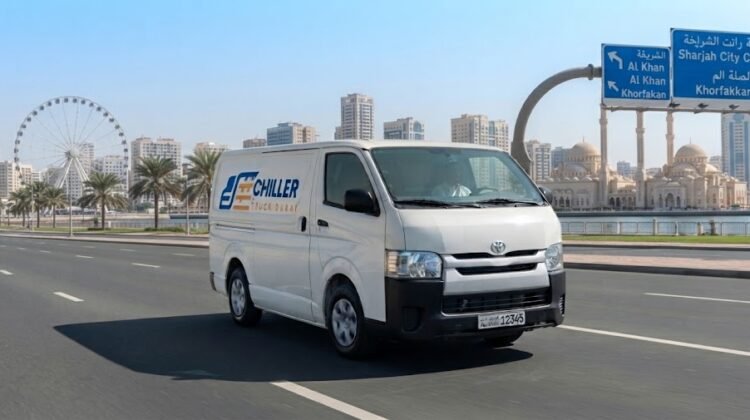
What Size Chiller Van or Truck Do You Need? A UAE Capacity Guide
Choosing the right refrigerated vehicle size can make a major difference to your delivery cost and efficiency.
Rent a vehicle that is too small, a chiller van or truck, and you may need two trips, increasing fuel, labor, and delivery time while creating another opportunity for the cold chain to be disrupted Chiller Van or Truck.
Choose a vehicle that is much larger than the Chiller Van or Truck necessary, and you may end up paying for refrigerated space you are not using.
The goal is right-sizing: selecting the smallest refrigerated vehicle that can safely carry your complete load in one trip while allowing appropriate airflow and handling space Chiller Van or Truck.
This Chiller Van or Truck size guide explains how to choose the right vehicle based on three things:
- Cargo volume
- Cargo weight
- Cargo shape and dimensions
For businesses arranging refrigerated transport in the UAE, Chiller Truck Dubai can help match vehicle capacity to the actual load rather than simply recommending the largest available truck Chiller Van or Truck.
Important: Capacities, pallet counts and payload figures in this guide are indicative examples. Chiller Van or Truck Actual capacity depends on the specific vehicle Chiller Van or Truck chassis, body dimensions, refrigeration installation, payload rating and configuration. Always confirm the exact specifications before booking Chiller Van or Truck.
Start With the Three Questions That Decide Vehicle Size
Before choosing a refrigerated van or Chiller Van or Truck , answer these three questions.
1. How much cargo do you have by volume?
Estimate the number of:
- Pallets
- Crates
- Cartons
- Containers
- Boxes
Also consider whether the products can be stacked safely.
A load occupying 3 m³ may require a different vehicle Chiller Van or Truck from a load occupying the same weight but 6 m³.
2. How much does the cargo weigh?
Weight is just as important as volume.
Dense products such as:
- Frozen meat
- Bottled beverages
- Dairy products
- Canned food
- Packaged food
can reach a vehicle’s payload limit before the Chiller Van or Truck cargo compartment is physically full.
3. What shape is the cargo?
Some products are light but require significant vertical or horizontal space Chiller Van or Truck.
Examples include:
-
- Cut flowers
-
- Hanging garments
-
- Bakery displays
-
- Catering equipment
-
- Tall crates
In these situations, internal height can matter more than payload Chiller Van or Truck.
Whichever limit you reach first determines the vehicle you need.
The UAE Refrigerated Vehicle Size Ladder
The following is a practical indicative capacity guide rather than a Chiller Van or Truck specification sheet for every vehicle on the UAE market.
| Vehicle Type | Indicative Payload | Indicative Pallet Capacity | Typical Use |
| Small Chiller Van | Up to ~1,000 kg | 1–2 pallets | Catering, last-mile deliveries, small loads |
| Standard / Panel Chiller Van | ~1,000–1,500 kg | 2–3 pallets | City distribution, restaurant supply |
| High-Roof Chiller Van | ~1,000–1,500 kg | 2–3 pallets, with extra height | Flowers, garments, bakery, tall crates |
| 3-Ton Chiller Truck | ~3,000 kg | 4–6 pallets | Medium-volume distribution |
| 5–7-Ton Chiller Truck | ~5,000–7,000 kg | 8–12 pallets | Larger distribution and factory dispatch |
| 10-Ton Reefer Truck | ~10,000 kg | 12–16+ pallets | Bulk and inter-emirate distribution |
Actual pallet capacity depends on pallet dimensions, internal body dimensions, access doors, wheel arches, stacking requirements and the need to maintain airflow.
Operator Insight: Weight Often Wins
For dense chilled and frozen cargo, businesses often underestimate the importance of payload.
A truck may have enough physical space for a large number of cartons, but if those cartons contain dense products such as bottled drinks or frozen meat, the payload limit can be reached first.
For these loads, calculate the total weight in kilograms, including packaging and any applicable ice or handling materials.
Do not choose a vehicle simply because everything appears to fit physically.
Sizing by Pallets: When Volume Is the Main Constraint
If your products are palletized, pallet count is one of the easiest ways to estimate the required vehicle Chiller Van or Truck.
As a general starting point:
-
- 1–3 pallets → Chiller van
-
- 4–6 pallets → 3-ton chiller truck
-
- 8–12 pallets → 5–7-ton chiller truck
-
- 12+ pallets → 10-ton reefer truck
However, pallet count alone does not tell the whole story.
A refrigerated vehicle needs enough room for appropriate air circulation. Packing a box completely solid from floor to roof can restrict cold-air movement and create warmer areas within the cargo Chiller Van or Truck.
For that reason, do not plan capacity right up to the theoretical maximum.
Leave appropriate space for:
-
- Air circulation
-
- Safe loading
-
- Door access
-
- Product protection
-
- Unloading
If you have 3 pallets that are unusually tall or cannot be stacked, for example, you may need a larger body even though the pallet count appears suitable for a smaller vehicle.
Sizing by Weight: The Key for Dense Cargo
Weight becomes the deciding factor when cargo is particularly dense.
Start by calculating the actual total shipment weight, including packaging where relevant.
For example, imagine a load that physically occupies enough space to fit inside a van but weighs approximately 2,000 kg.
The volume may look like a van-sized load, but the weight means a larger vehicle may be required.
Overloading a vehicle is not a safe way to save money.
When weight and volume give different answers, you should choose a vehicle that can legally and safely handle the required payload.
Common weight-heavy cargo
-
- Frozen meat
-
- Bottled drinks
-
- Dairy products
-
- Packaged beverages
-
- Bulk food products
-
- Heavy catering supplies
For these products, tell the transport provider the actual weight, not just the number of boxes Chiller Van or Truck.
Sizing by Load Shape: Tall or Awkward Cargo
This is one of the most overlooked parts of vehicle selection.
Not all cargo is dense.
Some products are relatively light but require a lot of vertical or horizontal space.
Cut flowers
Flower arrangements may require tall containers and cannot simply be stacked on top of one another.
Garments
Temperature-sensitive garments or specialist clothing may need to remain on rails rather than being compressed into cartons.
Bakery and patisserie displays
Tall cakes, display items and fragile Chiller Van or Truck bakery products may require additional vertical clearance.
Catering equipment
Empty catering containers, trays and equipment can be bulky while remaining relatively lightweight.
For these loads, a high-roof chiller van can be more practical than moving directly to a larger truck.
The extra internal height provides additional flexibility without paying for a much larger vehicle.
Don’t Forget the Door and the Route
Vehicle capacity is not only about how much fits inside the cargo box.
The vehicle also needs to be able to reach the pickup and delivery points. Chiller Van or Truck.
Access matters
A large refrigerated truck may have excellent capacity but still be unsuitable for a particular delivery location.
Consider:
-
- Loading dock size
-
- Road width
-
- Parking availability
-
- Building access
-
- Delivery restrictions
-
- Turning space
-
- Low-clearance areas
A smaller van that can reach the customer may be more useful than a large truck that cannot access the delivery point.
Tail-lift requirements
Heavy pallets can also create loading and unloading challenges.
If there is no forklift available at either the pickup or delivery location, you may need a vehicle equipped with a suitable tail lift.
This should be discussed before booking.
A vehicle that has enough payload but Chiller Van or Truck cannot practically load or unload the cargo is not the right vehicle.
Bigger Isn’t Always Cheaper
It can be tempting to “size up just to be safe.”
But bigger refrigerated vehicles generally cost more to rent and operate.
You may also be paying to cool unused cargo space.
The objective should not be:
“What is the biggest vehicle I can afford?”
It should be:
“What is the smallest suitable vehicle that can complete this delivery safely in one trip?”
Right-sizing can help control:
-
- Rental cost
-
- Fuel consumption
-
- Operating cost
-
- Loading time
-
- Delivery efficiency
For businesses comparing different vehicle Chiller Van or Truck sizes, the vehicle’s capacity should always be considered alongside its rental cost.
How Temperature Requirements Affect Vehicle Choice
Capacity is not the only consideration.
The vehicle must also be capable of maintaining the required temperature for the cargo.
For chilled products, the required temperature should be confirmed before selecting the vehicle. Chiller Van or Truck.
For example:
-
- Fresh produce may have product-specific chilled requirements.
-
- Dairy products require controlled refrigerated conditions.
-
- Frozen food requires sub-zero transportation.
-
- Pharmaceuticals may have strict manufacturer-specified temperature ranges.
A larger vehicle is not automatically better if its refrigeration system is not suitable for your product.
Always match capacity and payload and temperature requirement.
Quick Decision Summary
Use this as a starting point:
Small or Standard Chiller Van
Best for:
-
- Catering deliveries
-
- Restaurant supply
-
- Last-mile deliveries
-
- Small food orders
-
- 1–3 pallet loads
High-Roof Chiller Van
Best for:
-
- Flowers
-
- Hanging garments
-
- Tall bakery products
-
- Tall crates
-
- Bulky but lightweight cargo
3-Ton Chiller Truck
Best for:
-
- 4–6 pallets
-
- Medium distribution
-
- Depot-to-store deliveries
-
- Larger catering requirements
5–7-Ton Chiller Truck
Best for:
-
- 8–12 pallets
-
- Larger distribution operations
-
- Factory dispatch
-
- Multiple-store deliveries
10-Ton Reefer Truck
Best for:
-
- 12+ pallets
-
- Bulk distribution
-
- Large-volume shipments
-
- Longer inter-emirate routes
These are indicative categories. The final choice should always be based on the actual dimensions, weight, pallet configuration and vehicle specifications.
A Simple Example: Choosing the Right Size
Imagine a catering company has:
-
- 5 standard pallets
-
- Total weight of 2,400 kg
-
- Chilled food
-
- One Dubai delivery route
A small van is unlikely to be suitable because both the pallet count and payload exceed typical small-van capacity.
A 3-ton chiller truck may be a more appropriate starting point, subject to the actual internal dimensions and payload rating of the specific truck.
Now consider a florist with:
-
- 2 pallets
-
- Total weight of only 500 kg
-
- Tall flower arrangements
-
- No stacking allowed
The florist may not need a larger truck.
A high-roof chiller van could provide the necessary height while remaining more practical for city deliveries.
This demonstrates why weight, volume and shape must all be considered together.
What Information Should You Give the Rental Company?
If you want an accurate vehicle recommendation, provide:
-
- Cargo type
-
- Total weight
-
- Number of pallets
-
- Pallet dimensions
-
- Number of cartons/crates
-
- Maximum cargo height
-
- Required temperature
-
- Pickup location
-
- Delivery location
-
- Number of delivery stops
-
- Loading/unloading equipment available
The more accurate these details are, the easier it is to select the correct vehicle.
Instead of saying:
“I need a chiller truck.”
Say:
“I have 5 pallets of chilled dairy, approximately 2,400 kg total, with pickup in Dubai and delivery to Abu Dhabi.”
That gives the operator enough information to recommend an appropriate vehicle category.
Frequently Asked Questions
Q: How many pallets fit in a chiller van?
Ans: A typical refrigerated van may accommodate approximately 1–3 standard pallets, depending on the vehicle’s internal dimensions and configuration.
If you need approximately 4–6 pallets, a 3-ton chiller truck may be more appropriate.
Always confirm the exact pallet capacity of the vehicle you are renting.
Q: What is the payload of a 3-ton chiller truck?
Ans: As an indicative category, a 3-ton chiller truck may have around 3,000 kg of payload capacity.
The actual legal payload can vary depending on the chassis, body construction, refrigeration equipment and vehicle configuration.
Confirm the specific truck’s payload before loading.
Q: Should I size by weight or by volume?
Ans:Use whichever reaches the vehicle’s limit first.
Dense products such as frozen meat and bottled drinks may reach the payload limit before filling the cargo compartment.
Light but bulky products such as flowers may reach the volume or height limit first.
If weight and volume disagree, the vehicle must be capable of safely handling both requirements.
Q: Can one vehicle carry both chilled and frozen cargo?
Ans: Not automatically.
A standard refrigerated cargo compartment generally operates around one temperature range at a time.
If chilled and frozen products must travel together, an appropriately designed partitioned vehicle with separate temperature zones may be required, or separate vehicles may be more suitable.
Do not assume that one temperature setting is suitable for both.
Q: What if my load is tall but not heavy?
Ans: Consider a high-roof chiller van.
The additional vertical clearance can make it suitable for flowers, hanging garments, tall bakery displays and other lightweight but high-volume cargo.
Q: Is a bigger vehicle safer to over-rent?
Ans: No.
A larger vehicle may provide additional space, but that does not automatically make it more economical or operationally better.
If the vehicle is substantially oversized for the load, you may pay for unused refrigerated capacity.
The goal is to select a vehicle that safely accommodates the cargo in one trip without unnecessary excess capacity.
Q: The Bottom Line: Choose Capacity Before You Choose the Vehicle
Ans: The right refrigerated vehicle is determined by more than simply the number of boxes you have.
Before booking, consider:
Volume + Weight + Load Shape + Temperature + Route Access
If your cargo is dense, prioritize payload.
If it is tall or bulky, consider internal dimensions and high-roof options.
If it is palletized, calculate pallet count while allowing enough space for safe loading and airflow.
And if you are unsure, give the operator your cargo details rather than guessing.
Chiller Truck Dubai can help businesses assess their refrigerated transport requirements based on cargo weight, pallet count, dimensions, temperature and route.
Not Sure Which Chiller Van or Truck You Need?
Send Chiller Truck Dubai the following details:
Cargo type + pallet count + total weight + dimensions + required temperature + pickup + delivery.
The appropriate vehicle can then be selected from a chiller van through to a larger refrigerated truck, depending on the actual requirements.
For current vehicle options and indicative capacity information, review the available fleet and capacity guide before booking.
The best refrigerated vehicle is not the biggest one—it is the right-sized one that safely moves your complete load in one trip.
